Radiations in tropical alpine regions
Tropical alpine habitats are among the most peculiar environments on Earth: they sit close to the equator, so day length barely changes across the year, yet elevation pushes temperatures into a daily freeze-thaw cycle more typical of a temperate winter than a tropics. Because they occur as isolated “sky islands” on separate mountains and mountain ranges, each tropical alpine area is effectively a habitat island, colonized independently and shaped by its own history of glaciation, isolation, and reconnection. This makes tropical alpine floras an ideal natural experiment for studying diversification: how does the same kind of extreme environment, arising independently on different continents, shape the species that come to inhabit it?
My work compares the two largest tropical alpine systems in the world: the Afroalpine of the East African mountains and the Páramo of the northern Andes in South America. Together with colleagues from Charles University in Prague, we reconstruct the evolutionary history of the plant lineages that dominate these habitats, to understand how past climatic changes and mountain-building processes have driven their diversification. This has involved building the most complete phylogenies to date for several characteristic Asteraceae genera, including the giant rosette-forming Dendrosenecio of the Afroalpine, and the Andean genera Oritrophium and Loricaria.
 Dendrosenecio ‘forest’ in the East African tropical alpine ecosystem
How old and how stable are these habitats?
Together with colleagues in Norway, I investigated the age of the East African Afroalpine flora, and found it to be surprisingly young, disturbed by repeated climatic shifts, and far from saturated with species (PNAS). Building on this, I developed a climate-based delimitation of the tropical alpine ecosystem so that its present-day extent could be compared directly with its extent during the last glacial maximum, giving a way to estimate how stable these habitats have actually been through time (Journal of Systematics and Evolution).
Why is the Páramo so much richer in species than the Afroalpine?
Using this same climate-based delimitation, I compared the Páramo and the Afroalpine directly, since both experience similar climatic conditions yet differ dramatically in species richness. Together with colleagues from the Czech Republic, Norway, Ecuador, and Ethiopia, we found that this difference traces back to how species partition their resources: Andean species occupy larger and more separated ecological niches and geographic ranges than their Afroalpine counterparts, which appears to allow more species to coexist in the Páramo (Global Ecology and Biogeography).
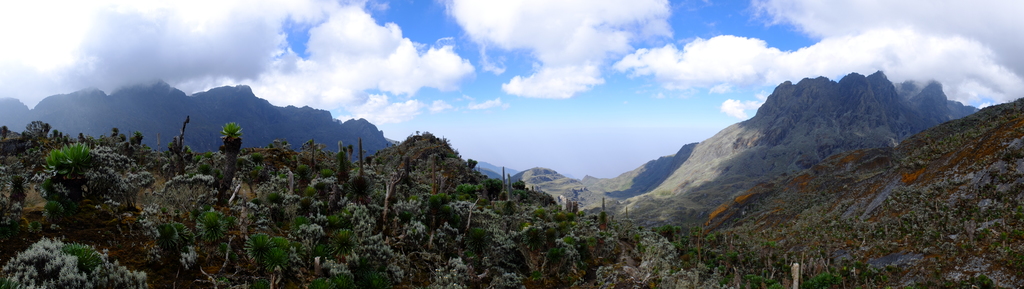 Afroalpine vegetation in the East African mountains
Alongside the evolutionary questions, working with lineages this young and this rapidly radiating has meant confronting a lot of gene tree discordance, so a good part of this project has also been methodological: developing and testing workflows to distinguish incomplete lineage sorting from hybridization as competing explanations for that discordance (see Tools & Workflows)).